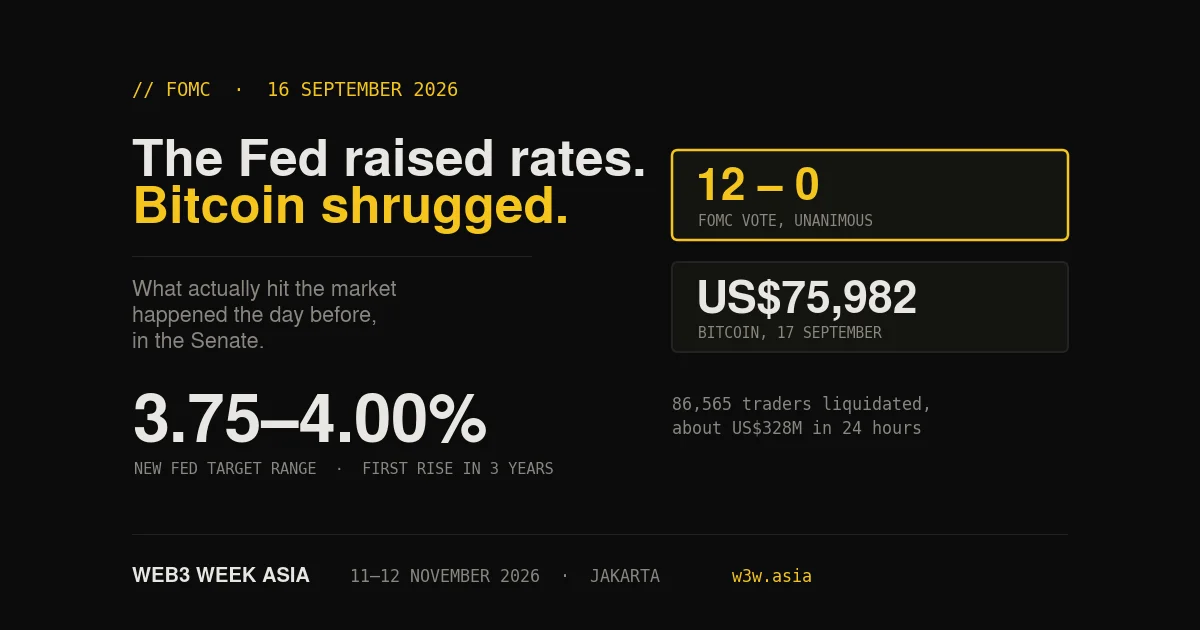
The Federal Reserve raised interest rates on 16 September 2026, its first increase in more than three years. The target range moved a quarter point, to 3.75 to 4 per cent.
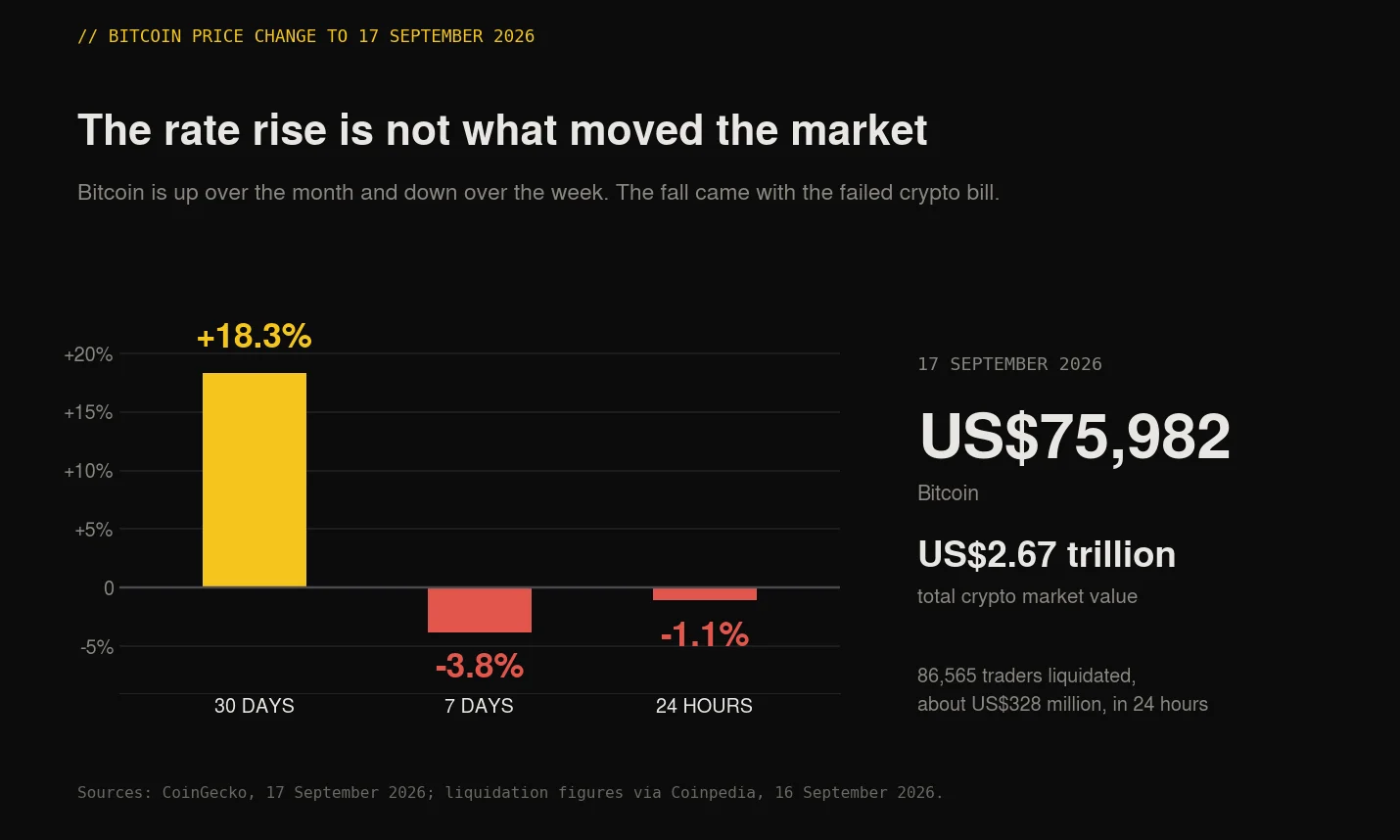
Bitcoin barely noticed. It sat near 76,000 dollars before the decision and near 76,000 dollars after it.
What did move the market happened the day before, and had nothing to do with the Fed.
Key Facts
The decision: a quarter-point rise to a target range of 3.75 to 4 per cent, announced 16 September 2026. The Fed last raised rates more than three years ago, and had been cutting as recently as late 2025.
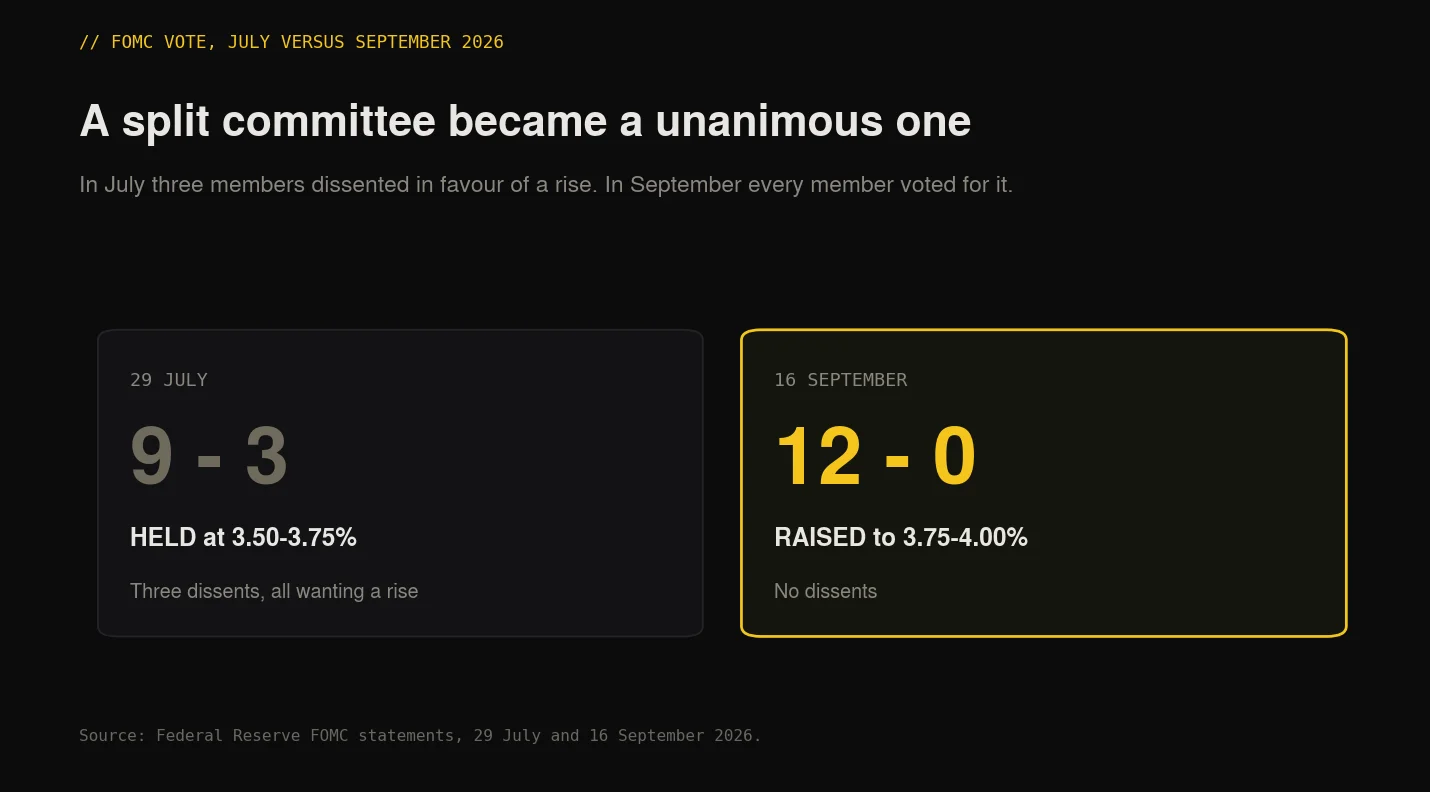
The vote: 12 to 0. Unanimous. At the July meeting the Committee held rates on a 9 to 3 vote, with all three dissenters wanting a rise.
The reason given: "Inflation remains elevated. Today's policy action will support a timelier return to the Committee's 2 percent goal," the FOMC statement said, adding that "uncertainty remains elevated owing, in part, to geopolitical developments."
The market: Bitcoin at about 75,982 dollars on 17 September, down 1.1 per cent on the day and 3.8 per cent on the week, but still up 18.3 per cent over thirty days. Total crypto market value about 2.67 trillion dollars.
The damage: roughly 86,565 traders liquidated for about 328 million dollars in twenty-four hours - most of that pressure arriving before the Fed spoke, after the US Senate failed to advance its crypto market structure bill on 15 September.
Why a rate rise did almost nothing
The textbook says higher rates hurt assets that pay no income. Cash and government bonds start paying more, so money that was reaching for risk no longer needs to.
That logic is sound, and it did not apply here, for one reason: the market had already done the work. By the morning of the decision, rate markets put the probability of a rise at close to 90 per cent. A price does not move on news that is already inside it. If everyone has positioned for a hike, the hike itself is an administrative event.
This is the most commonly misread relationship in crypto. Rate decisions matter enormously. Rate announcements usually do not. The move happens in the weeks before, as expectations shift - in this case through late August and early September, when an inflation print pushed the odds from a coin flip to near certainty.
What actually hit the market
On 15 September, the day before the Fed, the US Senate failed to advance the CLARITY Act, the bill that would have settled which regulator supervises which digital assets. The cloture vote fell well short of the sixty needed, and several senators who had helped negotiate the bill voted against it.
That is what the liquidations were about.
The distinction matters because the two events point in opposite directions for planning. A rate rise is cyclical: rates go up, later they come down, and the cycle is legible. A failed regulatory bill is structural: it removes a date from the calendar that a lot of capital was organising around, and replaces it with nothing.
The unanimous vote is the real signal
The number worth carrying out of this week is not 4 per cent. It is 12 to 0.
In July, the Committee held rates and three regional presidents dissented because they wanted an increase. That is a split committee: a majority holding a line against internal pressure. Six weeks later every member voted to raise. Nobody dissented in the other direction, and nobody argued for waiting.
A single rise by a divided committee reads as insurance against an energy shock. A unanimous rise by the same committee reads as a decision about direction. Chair Kevin Warsh gave the framing himself: "We must be confident that underlying inflation is moving to our objective, clearly and at sufficient speed."
That is not the language of one and done.
For anyone planning a 2027 budget around cheaper money, that sentence is more consequential than the quarter point itself.
What this does in Indonesia
Higher US rates strengthen the dollar and pull capital toward US assets. Emerging market currencies feel it first, and the currency feeds through to everything else.
Bank Indonesia has been positioned for this since May, when it raised its own policy rate citing the war in the Middle East and capital outflows from emerging markets into US bonds. It has held at 5.75 per cent since June.
The practical change this week is small but real. Before the Fed moved, the gap between Indonesia's policy rate and the top of the US range was 2.00 percentage points. It is now 1.75. That spread is part of what makes holding rupiah worthwhile rather than converting to dollars, and it just got thinner.
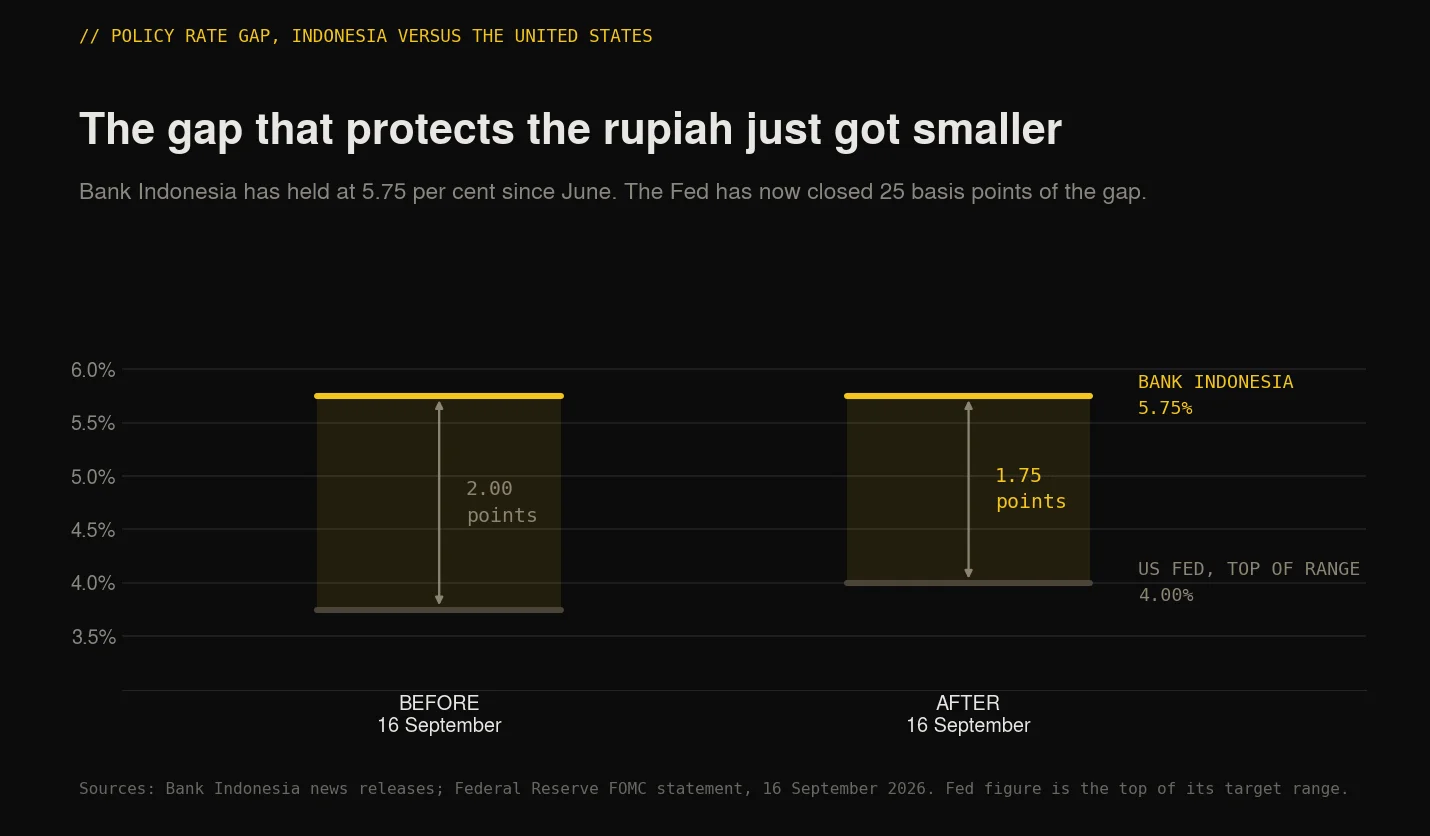
For domestic crypto participants that creates two pulls at once. Rupiah deposits paying 5.75 per cent compete for the same savings that might otherwise buy crypto. A weaker rupiah makes dollar-denominated assets look like protection. Which force wins is the most practical question in this market over the next two quarters, and it is decided in Washington rather than Jakarta.
What to watch next
Whether Bank Indonesia responds. It has held for three months. A narrower gap and a unanimously hawkish Fed change the arithmetic of that decision.
The dollar over the coming fortnight. The Fed reaches Indonesia as a currency event before it reaches anyone as a crypto event, and the currency reaction takes days rather than minutes.
Whether anything replaces the failed bill. The rate cycle will resolve itself either way. Regulatory clarity will not resolve itself at all.
Frequently Asked Questions
What did the Fed decide in September 2026?
It raised the federal funds target range by a quarter point to 3.75 to 4 per cent on 16 September 2026, on a unanimous 12 to 0 vote. It was the first increase in more than three years.
Why did Bitcoin not fall after the Fed raised rates?
Because the rise was already priced in. Rate markets had put the probability near 90 per cent before the meeting, so the announcement contained no new information. The selling earlier that week came from the failed US crypto market structure bill, not from the Fed.
Do higher interest rates hurt crypto?
Over time, generally yes, because assets that pay no yield compete against cash that does. But the effect arrives as expectations shift, not on the day a decision is announced. By the time the decision is made, the price has usually already moved.
How do US rates affect the Indonesian crypto market?
Through the currency. Higher US rates strengthen the dollar and draw capital out of emerging markets, pressuring the rupiah. Bank Indonesia holds its policy rate at 5.75 per cent, and the gap to the US rate narrowed from 2.00 to 1.75 percentage points after this decision.
Is the Fed going to raise rates again?
That is not knowable. What is known is that the Committee moved from a 9 to 3 split in July to a unanimous vote in September, and that the Chair said the Fed must be confident inflation is falling "clearly and at sufficient speed". Markets read unanimity as a signal about direction rather than a single adjustment.
The bottom line
Two things happened in Washington in two days. One was a rate rise that the market had already absorbed and shrugged at. The other was a regulatory failure that nobody had fully priced, and that is where the losses came from.
The lesson is about which kind of uncertainty actually costs money. Cyclical uncertainty gets priced in advance because everyone can see the calendar. Structural uncertainty does not, because there is no date to price against.
For teams operating in Indonesia, the chain runs the same way it has all year: US rates move the dollar, the dollar moves the rupiah, and the rupiah moves domestic crypto behaviour long before any of it shows up in a Bitcoin chart. Understanding both halves of that chain matters more now that the gap protecting the rupiah has narrowed.
Those two halves are usually discussed in different rooms. At Web3 Week Asia, on 11-12 November in Jakarta, the Indonesia Crypto Outlook track puts domestic exchanges, local funds and regulators on the same stage, which is where the second half of the chain actually gets answered.
Sources
Federal Reserve FOMC statement, 16 September 2026: https://www.federalreserve.gov/newsevents/pressreleases/monetary20260916a.htm
Background on how this market is structured: our guide to Indonesia's crypto market at https://www.w3w.asia/articles/indonesia-crypto-market-2026-jakarta-web3-hub
Other figures in this article are drawn from CoinGecko on 17 September 2026 for price and market value, Coinpedia on 16 September 2026 for liquidation data, Bank Indonesia news releases for the BI-Rate, and CNBC and Coingape reporting for the 15 September Senate vote.
Methodology: prices and percentage changes are snapshots from 17 September 2026 and move continuously; figures differ between providers depending on the time of capture. Rate probabilities referenced are market prices, not forecasts. The FOMC vote count and quotations are taken from the Federal Reserve's own published statement rather than secondary coverage.
This article is for information only and is not investment advice.