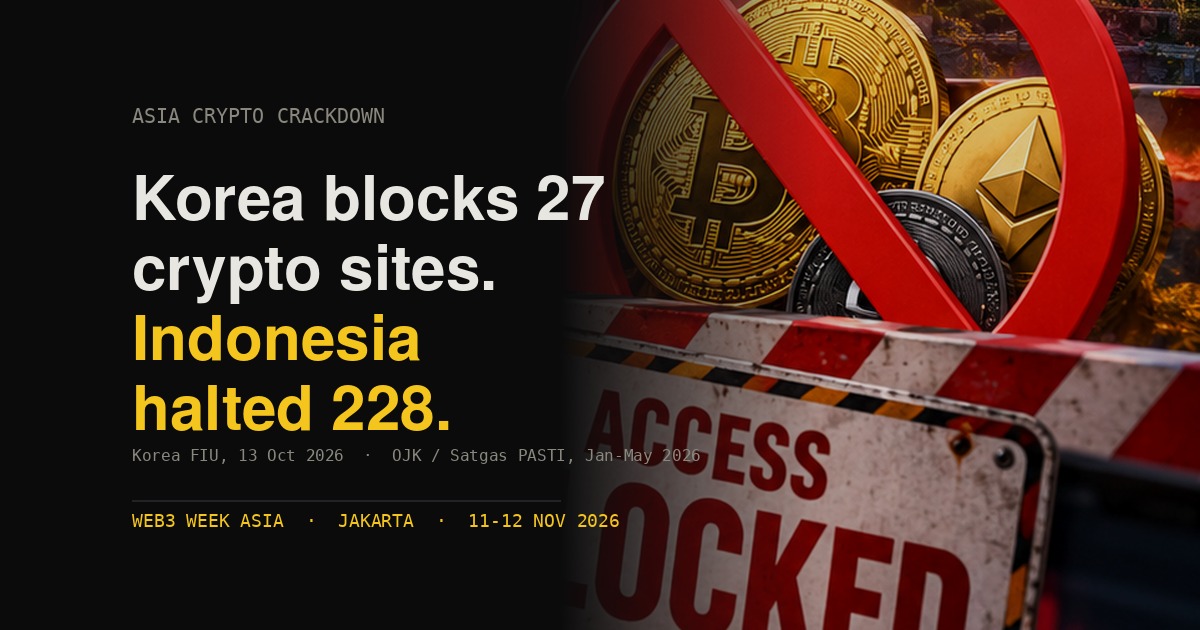
South Korea's Financial Intelligence Unit (FIU) announced on Tuesday, 13 October 2026, that it is cutting domestic web access to 27 unregistered crypto exchanges, including KuCoin, BitMart and MEXC. Most coverage stopped at the names. The more important line is procedural: regulators can now seek a website block as soon as they detect unregistered activity, without waiting for a court ruling or for customers to lose money.
That shifts enforcement from reacting to damage to acting on licence status alone. Indonesia has been running a similar playbook at a much larger scale, with 228 illegal crypto trading platforms halted between January and May 2026, according to OJK and the Satgas PASTI task force. One name sits on both lists: KuCoin.
Licensing and enforcement against offshore platforms are part of the regulatory discussion at Web3 Week Asia, held on 11-12 November 2026 in Jakarta.
What Korea did. The FIU ordered access restrictions on 27 websites of unregistered exchanges after the communications standards commission reviewed them on 6 and 7 October 2026.
How it works. Overseas-operated sites are blocked inside Korea. Domestically operated services face termination.
What triggers a block. Korean-language service, marketing aimed at Korean users, or support for won transactions, as reported by Cointelegraph and Finance Magnates.
What is still open. The FIU did not say how long the blocks last and did not set a registration deadline.
Indonesia's comparison point. 228 illegal platforms halted from January to May 2026, against 28 licensed digital asset traders as of September 2026.
From app stores to websites: why the procedure matters
The new step extends existing restrictions. In 2025, Korean authorities limited downloads and updates of unregistered exchange apps, including 17 apps on Google Play, according to both Cointelegraph and Finance Magnates.
The procedural change matters more than the count of 27. According to CoinDesk and Finance Magnates, the FIU no longer needs a court ruling or evidence of customer losses before it asks for a block. It also said it will pursue replacement sites that reappear under new addresses.
CoinDesk reports that the FIU has referred 44 unregistered operators to investigators and that only 28 virtual asset service providers are registered in Korea. Finance Magnates reports that operating without registration can carry up to five years in prison or a fine of up to 50 million won.
Why Korean traders went offshore in the first place
The block targets demand that is already large. A joint study by CoinGecko and Tiger Research estimated that South Koreans moved about 160 trillion won, roughly US$110 billion, from domestic to foreign exchanges in 2025. FinanceFeeds and Tangem both reported the estimate, and CoinDesk cited the same US$110 billion figure. It is one research estimate, not an official statistic.
The reason Tangem's report gives is product scope: Korean exchanges are limited to spot trading, while offshore platforms offer derivatives and leverage. Korea's broader Digital Asset Basic Law, which would cover issuance, trading, custody and supervision, has been proposed but is not in force, according to CoinDesk.
Why this matters: a block removes access but does not add the products that pushed users offshore.
The user problem nobody can block away
The FIU itself warned that users of the blocked platforms may struggle to withdraw funds. It said it will work with the Digital Asset eXchange Alliance (DAXA) to help affected customers withdraw, with the operators' cooperation.
KuCoin told CoinDesk and Cointelegraph that "user assets remain safe and secure." BitMart, Phemex and MEXC had not responded to CoinDesk at the time of its report. Why this matters: losing local access is a practical risk for anyone still holding balances there.
The honest counterweight
A block is not proof of wrongdoing beyond registration. The FIU action concerns operating without registration under Korea's anti-money-laundering law. It is not a finding that any named exchange lost or misused customer funds.
The numbers are not like for like. Korea's 28 registered virtual asset service providers and Indonesia's 28 licensed digital asset traders are counted under different laws and categories. The matching figure is a coincidence.
Effectiveness is not established. No public data yet shows how much trading Korea's 2025 app restrictions moved back to registered exchanges, and Indonesia's 228 halted platforms have no published estimate of user volume attached.
Indonesia crypto enforcement: the same playbook, a different toolkit
Indonesia shares the core idea: a whitelist decides who may serve local users. OJK publishes the list of licensed digital asset traders, including company names, apps and official websites. At an industry session reported by REQnews in September 2026, OJK deputy director Andry Samudra urged users to check that a platform is on that whitelist, and noted that illegal operators often switch domains to evade blocks, the same problem Korea's FIU said it will chase.
The scale is larger. OJK executive head Adi Budiarso said at OJK's board briefing on 4 August 2026 that 228 illegal crypto platforms had been stopped up to May 2026, as reported by InvestorTrust. Infobank News published the Satgas PASTI list, dated June 2026, with KuCoin among the entries. On the licensed side, Kontan and Warta Ekonomi both reported that OJK counted 28 licensed traders as of September 2026, after PT Gudang Kripto Indonesia received its licence effective 22 September 2026.
Indonesia also uses price, not only access. Under PMK 50/2025, in force since 1 August 2025, sales on domestic platforms carry a 0.21% final income tax, while sales on foreign platforms carry 1%, according to Pajakku and Selular. On a Rp10 million sale, that is Rp21,000 versus Rp100,000. And unlike Korea, Indonesia allows regulated derivatives: digital financial asset derivatives transactions reached Rp4.56 trillion in August 2026, up 33.76% from July, per OJK figures reported by Kontan and Warta Ekonomi.
The market they protect is not small. OJK counted 23.21 million crypto consumer accounts and Rp23.16 trillion in crypto transactions in August 2026, according to the same two outlets.
Web3 Week Asia 2026: blockchain event in Jakarta, 11-12 November
Web3 Week Asia takes place on 11-12 November 2026 at the Grand Ballroom, Kuningan City, Jakarta, according to the official site. One of its four tracks, Indonesia Crypto Outlook 2026, focuses on where the local market and its rules are heading. The other tracks are Investor Meetups, Alpha Callers and Web3 Entrepreneur.
The 2025 edition drew more than 5,000 participants, over 100 speakers and more than 200 companies from more than 10 countries, according to the organisers. The 2026 speaker line-up is to be announced.
Frequently asked questions
When and where is Web3 Week Asia 2026?
Web3 Week Asia 2026 takes place on 11-12 November 2026 in Jakarta, Indonesia. It is a two-day crypto and blockchain event covering markets, regulation, infrastructure and venture investment across Southeast Asia.
Why did South Korea block 27 crypto exchange websites?
South Korea's Financial Intelligence Unit said the 27 platforms were serving Korean users without registering under the country's anti-money-laundering law. The block was announced on 13 October 2026 after reviews on 6 and 7 October 2026.
Is KuCoin licensed in Indonesia?
KuCoin appears on the Satgas PASTI list of illegal digital asset traders halted between January and May 2026, as published by Infobank News. Users should check OJK's current whitelist of licensed traders for the latest status.
How can Indonesian users check whether a crypto exchange is legal?
OJK publishes a whitelist of licensed digital asset traders with company names, apps and official websites. OJK counted 28 licensed traders as of September 2026.
What happens to funds on a blocked exchange in Korea?
Korea's FIU warned that withdrawals may become difficult. It said it will work with DAXA to help affected users withdraw, with the operators' cooperation.
Sources
CoinDesk, South Korea blocks 27 crypto exchanges: https://www.coindesk.com/policy/2026/10/13/south-korea-blocks-27-crypto-exchanges-including-bitmart-and-kucoin
Web3 Week Asia, Why Jakarta is becoming a Web3 hub: https://www.w3w.asia/articles/indonesia-crypto-market-2026-jakarta-web3-hub
Korea figures come from CoinDesk (13 October 2026), Cointelegraph (13-14 October 2026) and Finance Magnates (13 October 2026). The 2025 outflow estimate is from CoinGecko and Tiger Research as reported by FinanceFeeds (2 January 2026), Tangem and CoinDesk. Indonesia enforcement figures come from OJK statements reported by InvestorTrust (5 August 2026), Infobank News (23 June 2026) and REQnews (24 September 2026). Licensed trader counts, accounts, transactions and derivatives come from OJK's September board briefing as reported by Kontan and Warta Ekonomi (5 October 2026). Tax rates are from PMK 50/2025 as summarised by Pajakku and Selular.
Methodology: The Rp21,000 and Rp100,000 figures apply the 0.21% and 1% rates to a Rp10 million sale. The 2025 app-restriction month differs between sources (Cointelegraph says April 2025, Finance Magnates says March 2025 for Google Play), so only the year is given. The 228 figure is described as "up to May 2026" by InvestorTrust and "January to May 2026" by Infobank News and REQnews; these are consistent. MEXC is named on Indonesia's list by one outlet only and was excluded from the Indonesia comparison. Figures as of 15 October 2026, 08:00 WIB.
This article is for information only and is not investment advice