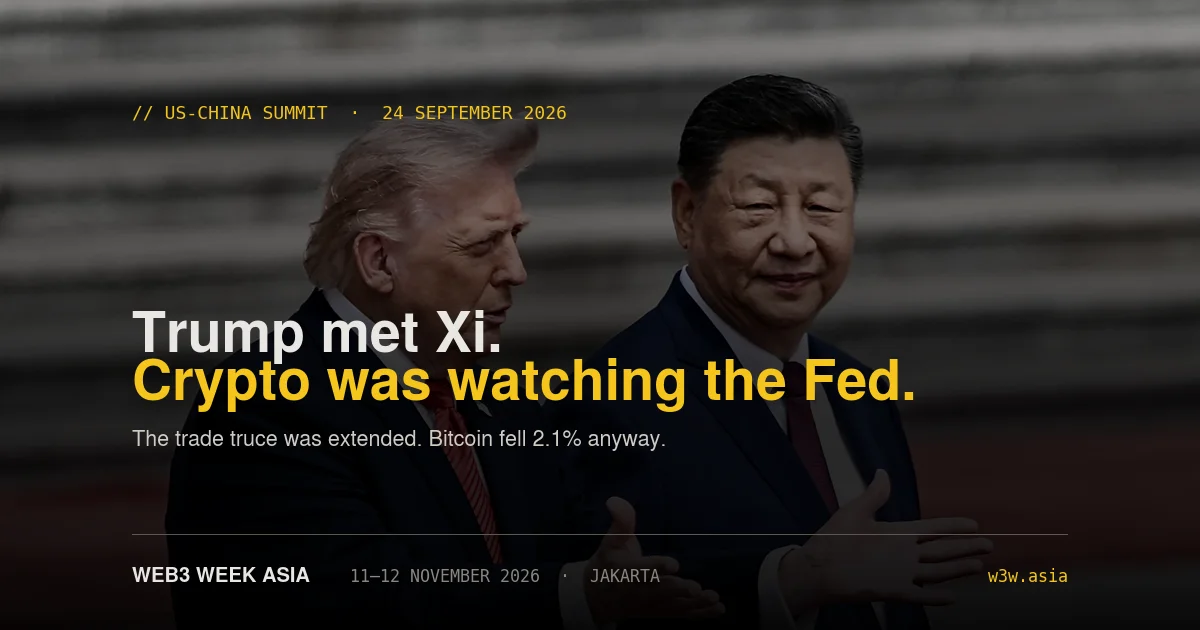
Xi Jinping landed in Washington on Wednesday 23 September for a three-day visit. By Thursday morning the US Treasury Secretary had announced that the trade truce between the two largest economies on earth was being extended, and the two presidents were sitting in the Oval Office calling it a great meeting.
Bitcoin fell 2.1 per cent.
Not because the summit went badly. Because of something happening in a different building entirely.
What was actually agreed
Scott Bessent confirmed that what both sides call the Busan Agreement, the trade truce struck when the two leaders met in South Korea in October 2025, has been extended from its expiry of 10 November 2026 to 10 January 2027.
That is a two-month extension, not a settlement. Bessent framed it as clearing room for what he described as a bigger deal rather than a series of smaller things. The agenda around it covers trade, artificial intelligence, rare earths, Iran and Taiwan.
Two months is worth reading carefully. It is long enough to keep tariffs from snapping back before the US midterms, and short enough that neither side has conceded anything permanent.
What crypto did instead
While that was being announced, bitcoin traded at about US$83,500, down roughly 2.1 per cent, after being rejected above US$87,000 the day before. Ether fell about 2.5 per cent to around US$2,650.
The driver named in market coverage was not China. It was the Federal Reserve. CME Group's FedWatch tool, as reported on Thursday, showed a 75.3 per cent probability of a rate increase in October and a 58.6 per cent chance of another in December. Inflation concerns have moved the market from expecting one more hike this year to pricing two.
That is the entire explanation for this week's reversal. A rally built on short covering, which we wrote about when bitcoin reclaimed US$85,000, ran into a rate expectation it could not absorb.
The last time these two met
This is where the useful pattern sits, and it argues against the genre of article currently telling you which coin to buy before the summit.
The two leaders last met in Busan on 30 October 2025. That meeting produced real outcomes: US tariffs on Chinese goods were cut to 47 per cent, China agreed to resume rare-earth exports and to buy American soybeans, and chip supply was on the table.
Bitcoin moved about one per cent.
In the same twenty-four hours, roughly US$611 million of long positions and US$200 million of shorts were liquidated. Most of that damage came before the meeting, triggered by Jerome Powell saying a December cut was far from a foregone conclusion.
A genuine trade breakthrough moved crypto by one per cent. A single sentence from the Fed chair moved it enough to wipe out six hundred million dollars of leverage. That is the transmission mechanism, and it has not changed.
Why Asian equities respond and crypto does not
Asian stock markets do price this summit directly, and they should. In the run-up this week the KOSPI, Taiwan's TAIEX and the Hang Seng all rose. Those indices are full of companies whose revenue depends on tariff schedules, rare-earth supply and chip export rules. A truce extension changes their forward earnings.
Bitcoin has no earnings and no supply chain. What it has is a price that moves inversely to the cost of dollar liquidity. Trade policy reaches it slowly, through growth and inflation, over quarters. Interest rate expectations reach it in minutes.
So the two markets are not being inconsistent with each other. They are pricing different variables, and only one of those variables was on the agenda in Washington.
What would change this
Three developments would make a US-China summit genuinely matter for digital assets.
A chip export decision that touches mining hardware or data centres. Semiconductor supply is the one agenda item with a direct physical link to this industry.
A Chinese move on stablecoins or digital yuan policy that affects Hong Kong. Hong Kong is where China's tolerance for regulated digital assets is being tested, and its stablecoin regime has been in force since August 2025.
A collapse rather than an extension. Markets price truces calmly. They do not price the truce failing.
None of those happened this week.
What it means from Jakarta
For an Indonesian trader, the practical read is about where to point your attention.
If you are watching summit headlines for a crypto signal, you are watching a screen that has historically produced a one per cent move. The variable that has actually moved your position this week is a probability published by a US futures exchange about a meeting in October.
That is not a comfortable conclusion for anyone who prefers geopolitics to monetary policy, but it is what the record shows. Indonesian transaction volume fell 28.2 per cent in July to Rp20.52 trillion even as registered accounts rose to 22.93 million, and none of that had anything to do with Washington or Beijing either.
The local market follows global dollar conditions with a lag, filtered through 26 licensed exchanges and whatever liquidity they can source. Understanding that chain is worth more than any summit take.
Web3 Week Asia: the Indonesia crypto event where this gets unpacked
Web3 Week Asia takes place on 11-12 November 2026 in Jakarta, Indonesia. It is a two-day blockchain event covering exactly this kind of question: which global variables actually reach Southeast Asian order books, and through which intermediaries.
The 2025 edition drew more than 5,000 participants, over 100 speakers and more than 200 companies.
The people who run Indonesian exchanges, allocate capital here and write the rules under POJK 27/2024 will be in the same building for two days in November. If you want to understand what moves this market, that is a more reliable source than a summit livestream.
Frequently asked questions
Did the Trump-Xi summit move bitcoin?
Not materially. Bitcoin fell about 2.1 per cent to roughly US$83,500 on 24 September, and market coverage attributed the decline to Federal Reserve rate expectations rather than the summit. When the two leaders met in Busan in October 2025 and agreed substantive tariff cuts, bitcoin moved about one per cent.
What was agreed at the Trump-Xi summit?
The US Treasury Secretary confirmed the Busan Agreement trade truce has been extended from 10 November 2026 to 10 January 2027. Talks also covered artificial intelligence, rare earths, Iran and Taiwan. No broader settlement was announced.
When and where is Web3 Week Asia 2026?
Web3 Week Asia takes place on 11-12 November 2026 in Jakarta, Indonesia. It is a two-day crypto and blockchain event covering markets, regulation, infrastructure and venture investment across Southeast Asia.
Sources
The extension of the Busan Agreement trade truce to 10 January 2027, confirmed by Treasury Secretary Scott Bessent: https://www.nbcnews.com/business/economy/us-china-extend-trade-truce-trump-rcna599525
What actually drove bitcoin back above US$85,000 the week before, our earlier analysis: https://www.w3w.asia/articles/bitcoin-85000-rally-september-2026
Summit details and agenda are from Al Jazeera and CNBC reporting of 23 and 24 September 2026. Current prices and the rate-hike probabilities are from Yahoo Finance citing CME FedWatch. The rejection above US$87,000 and intraday levels are from UseTheBitcoin. Outcomes of the October 2025 Busan meeting are from CNBC, Axios and PBS. The crypto reaction to that meeting, including liquidation totals and the Powell quote, is from FXStreet. Asian index moves are from market coverage of 21 September. Indonesian figures are from OJK as reported by CNBC Indonesia and Kompas.
Methodology: this article was written while the summit was still in progress, so it describes what had been announced by the morning of 24 September and nothing beyond that. No charts are included because prices moved several per cent during the day and a chart would freeze a number that was still changing. The FedWatch probabilities and the one-hour liquidation figure each come from a single outlet and are attributed in the text. The October 2025 comparison is drawn from one report of the crypto reaction, cross-checked against multiple reports of what the meeting itself produced.
This article is for information only and is not investment advice.